What is complex feedback and why do I need it?

Machine Learning v Human Learning.

Machine Learning (AI as it has been branded) has been around for 20 years. It just didn’t have the funding or commercial focus to make money until recently.

Currently, it tells us stuff that we tell it. It needs information and instruction to give an output, which mostly comes from us humans. The AI the majority of us have access to doesn’t learn further than how it has been programmed.

It certainly speeds things up and I, as someone with the attention span of a gnat, love it’s convenience. but let’s keep it real: it isn’t going to negate the need for service-led business, not yet.

But can it help us improve our businesses effectively? If AI relies on the information it is given, how does it compare to living things and how they learn?
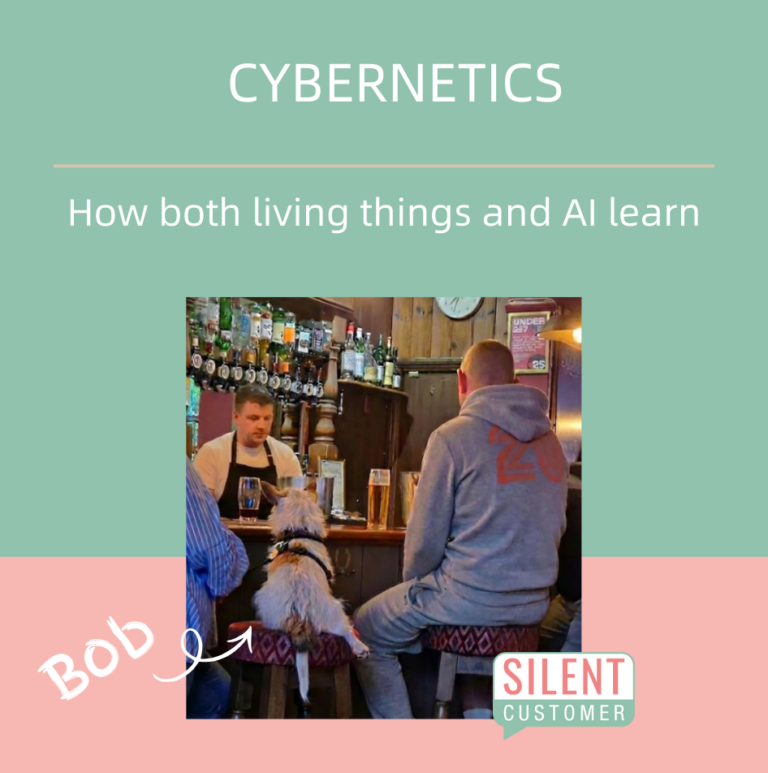
Cybernetics – What it is and how feedback affects learning.

There is a thing called cybernetics, which is how both living things and AI learn.

Cybernetic means relating to cybernetics – the science of control and communication in complex systems, whether living (like the brain) or artificial (like machines). It focuses on how systems self-regulate using feedback loops to achieve goals. Essentially, it studies ‘steermanship’: how systems steer themselves toward a purpose, whether it’s a thermostat adjusting temperature or a robot learning. 

Dogs learn that wanted behaviour gets them positive feedback in the form of a certain tone of voice and a treat, and unwanted behaviour gets a stern ‘NO!’ After a while, the positive voice alone is the learnt reward.

AI can learn from feedback. It can adapt it’s responses depending on the prompts that we put in (a process called ‘prompt chaining’). As a result it can perform more complex things than we would expect dogs to (sorry Bob) but not compared to the human brain, currently.

As humans, we are driven not just to survive but to thrive and we too react to feedback.

When we go to the gym, win competitions, buy stuff, drink alcohol, eat sugar, we get feedback in the form of dopamine. The dopamine is a reward so we want more.

We find calculus time-consuming, so we invent computers. Et cetera.

Simply put, we all need feedback if we want to achieve our goals. If we don’t ask for it, it will still find its way to us, but it may not deliver the outcome that we expected or wanted. It is, therefore, important to consider the type of feedback we ask for.

Why is complex feedback important?

In business, we do ask for feedback but not always for ‘complex’ feedback.

Google reviews are fine, but by their nature they generate only very basic responses and do not loop back with enough detail to adapt our processes effectively.

AI can summarise but it doesn’t make the feedback any more insightful.

Customer surveys are usually clumsily written with little understanding about human emotion or behaviour.

To improve customer satisfaction, in-depth feedback, that looks at several aspects of what our customer experience is, works best.

That’s where we come in.

Humans are complex and fickle, so stop worrying about AI taking your place and start worrying about your customer experience. Business has never been so competitive.

Mystery shopping delivers complex feedback so if you want your teams to deliver a better customer experience, get in touch!

We are a small team who have worked together studying humans for many years, including Bob, the Jack Russell.

https://www.silentcustomer.com/


Share:

Twitter
LinkedIn
Facebook

Related Posts

What is complex feedback and why do I need it?

Machine Learning v Human Learning. Machine Learning (AI as it has been branded) has been around for 20 years. It just didn’t have the funding or commercial focus to make money until recently. Currently, it tells us stuff that we tell it. It needs information and instruction to give an output, which mostly comes from us humans. The AI the majority of us have access to doesn’t learn further than how it has been programmed.

Read More »

Okay, it’s Fortnum’s, but EVEN SO!

This is Meghan and me on our annual Christmas pilgrimage to Fortnum’s. We do the rounds and then have a glass of bubbles and some mini sausages in the 3’6 Bar (never thought to ask why it’s called that). Anyway… later that day, I realised I must have left my phone on the sofa there. Doh! Mind you, if you’re going to leave your phone anywhere in London, right? The phone call. I phoned Fortnum’s,

Read More »

Behind the Scenes at Silent Customer: Experience, Resilience, and Real Service

Personally, and business-wise, it’s been an absolute bugger of a year so far.   My mother passed away in Feb after a short battle with Cancer. The day after she died the GP ‘fast-tracked’ my other half for suspected cancer. (It wasn’t – thankfully).   At the same time, I was suffering from awful bladder plain which has since been diagnosed as chronic and incurable.   I’ve had hand surgery, and there’s more besides.  

Read More »

Has the smaller pool of front of house talent made it harder to deliver a great service experience?

Employed people in hospitality are super expensive, difficult to come by, and it seems, lacking in basic people skills and practical logic. I ran my first restaurant as a general manager 30 years ago when I was 21. Food and labour costs were stressful to manage then. Chefs were difficult to come by, although not nigh-on-impossible as it is now.  However, front of house people dropped application forms off in droves. There was more choice

Read More »

How Flexible Office Spaces Can Win (or Lose) in the First 5 Minutes

In the world of flexible office spaces, first impressions matter more than most office space owners realise. Whether someone is stepping into your coworking environment for a tour, arriving for their first official day, or simply testing the waters with a day pass, the first five minutes often determine whether they will become a loyal member or quietly move on to the next option down the street. At Silent Customer, we specialise in uncovering these

Read More »

Stop Rudeness From Eroding Your Revenue

In hospitality, every detail matters from the flavour of the food to the ambience of the space. Yet one of the biggest influences on customer loyalty (and, ultimately, your bottom line) isn’t what’s on the plate or in the glass. It’s how your guests are treated by your team.     Unfortunately, many hospitality businesses underestimate just how much rudeness, detachment, or lack of engagement can cost them. You can have the most stunning menu

Read More »

Reputation Management

Mystery Visits

Phone & Online Audits

Free Training Tools

Free Training Tools

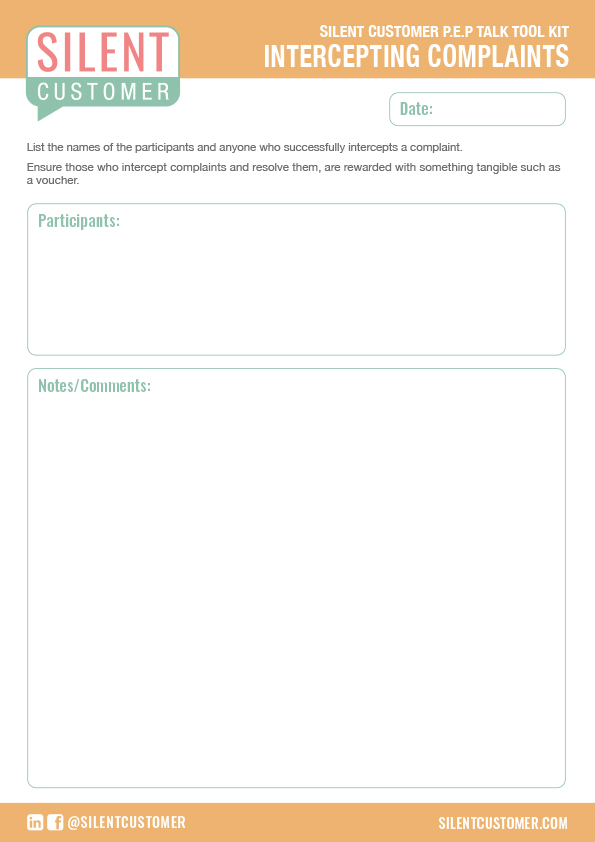
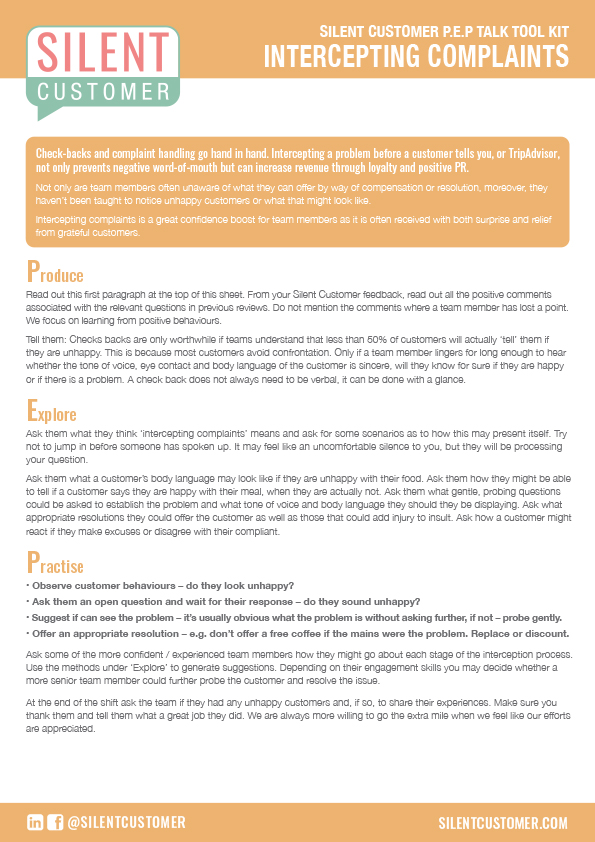
Intercepting Complaints

Check-backs and complaint handling go hand in hand. Intercepting a problem before a customer tells you, or Google, not only prevents negative word-of-mouth but can increase revenue through loyalty and positive PR.

Use our fun PEP talk sheets to support your front-line teams in learning how to avoid complaints.

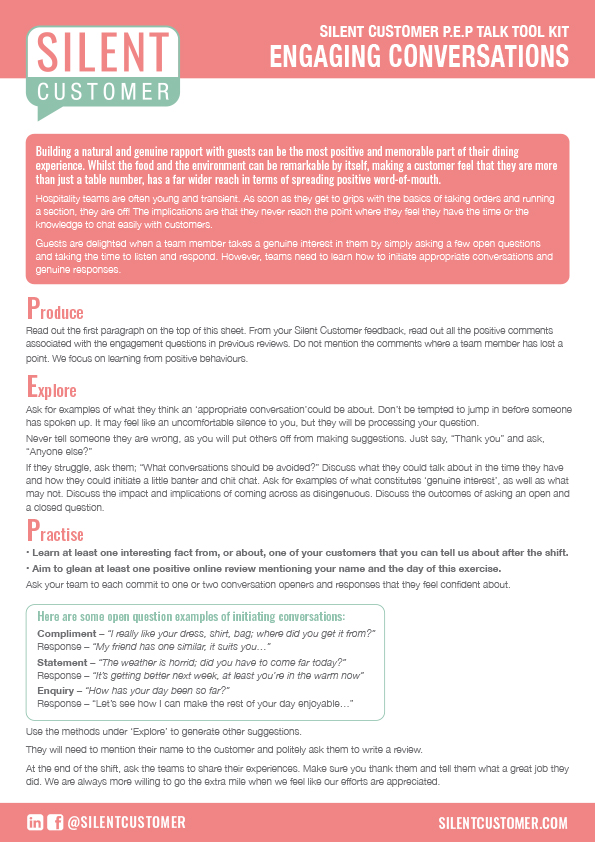
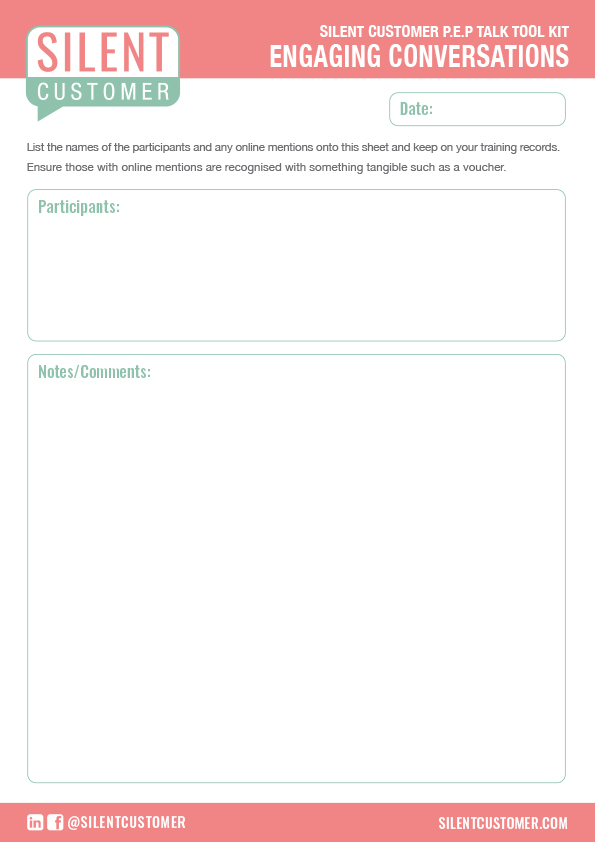
Engaging Conversations

Building a natural and genuine rapport with guests can be the most positive and memorable part of their dining experience. Whilst the food and the environment can be remarkable by itself, making a customer feel that they are more than just a table number, has a far wider reach in terms of spreading positive word-of-mouth.

Use our fun PEP talk sheet to support your front-line teams in learning how to have engaging conversations.

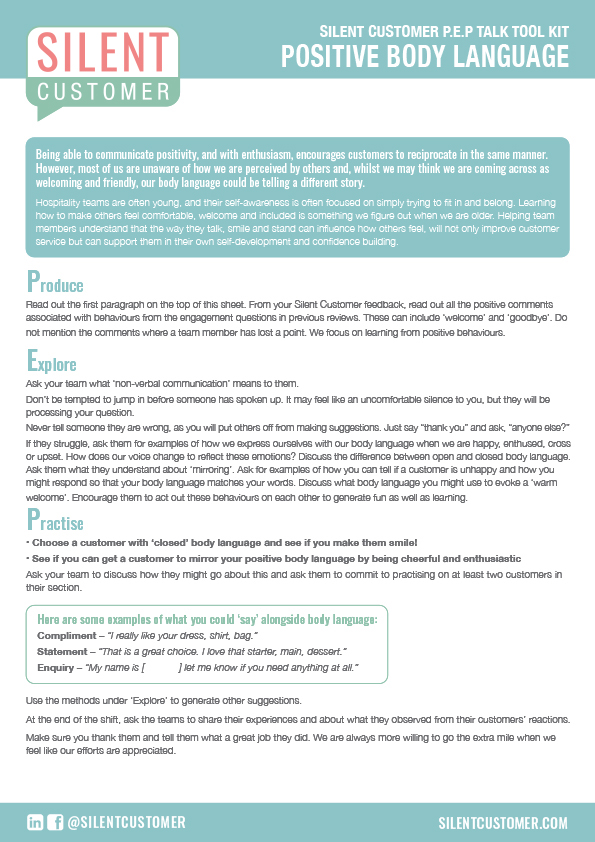
Positive Body Language

Being able to communicate positivity, and with enthusiasm, encourages customers to reciprocate in the same manner. However, most of us are unaware of how we are perceived by others and, whilst we may think we are coming across as welcoming and friendly, our body language could be telling a different story.

Use our fun PEP talk sheet to support your front-line teams in understand the importance of self-awareness.

Relevant Recommendations

Team members need good product knowledge to be able to describe and enthuse, but often don’t know what many of the dishes taste like. A lack of upselling is also often due to a lack of confidence in knowing where to start a conversation that leads to a recommendation.

Use our fun PEP talk sheet to support your front-line teams in learning how to upsell.