Creative Thinking in Hospitality

In hospitality, it’s often the smallest moments that leave the biggest impression.

That’s the message bestselling author, chef, and entrepreneur Erin Wade brought to life during her recent interview on The Chris Evans Breakfast Show on Virgin Radio. Sharing insights from her book The Mac & Cheese Millionaire, Wade offered a fresh perspective on frontline service — one that encourages teams to embrace creative thinking, micro-goals, and emotional intelligence.

creative thinking

One standout idea from Wade? Ask your team to focus on making just one table an hour feel really special.

That might sound simple — even too simple — but therein lies its power. Instead of overwhelming teams with vague targets like “smile more” or “deliver exceptional service,” this approach gives them a clear, achievable mission. Whether it’s offering a genuine compliment, anticipating a guest’s need, or going the extra mile with thoughtful detail, the focus becomes connection over perfection.

“It gives your team permission to take a moment, be present, and show care,” Wade explains. “That ripple effect improves the experience for everyone else too.”

Another innovative idea from Wade’s book involves a colour-coded communication system that empowers staff to safely and discreetly manage customer harassment. Rather than ignoring the issue or handling it solo, team members use a pre-agreed colour system to signal for backup or report concerns — without escalating the situation in front of guests.

It’s a simple but powerful example of designing for safety in hospitality — an environment where emotional labour is often invisible.

This system encourages team solidarity, reduces anxiety, and reinforces that no one has to face uncomfortable moments alone.

At Silent Customer, we believe creativity and emotional intelligence are essential ingredients in the hospitality mix — and body language is one of the most creative tools your team can master.

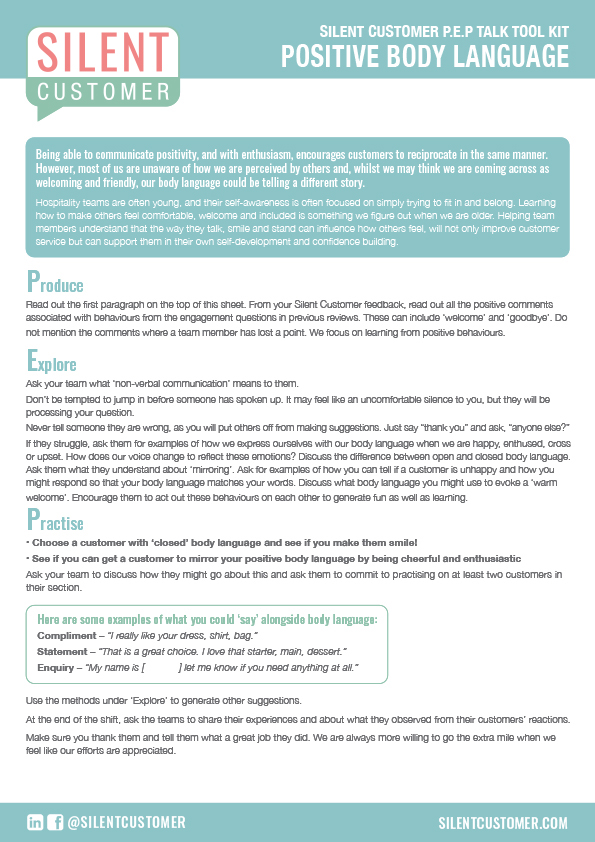
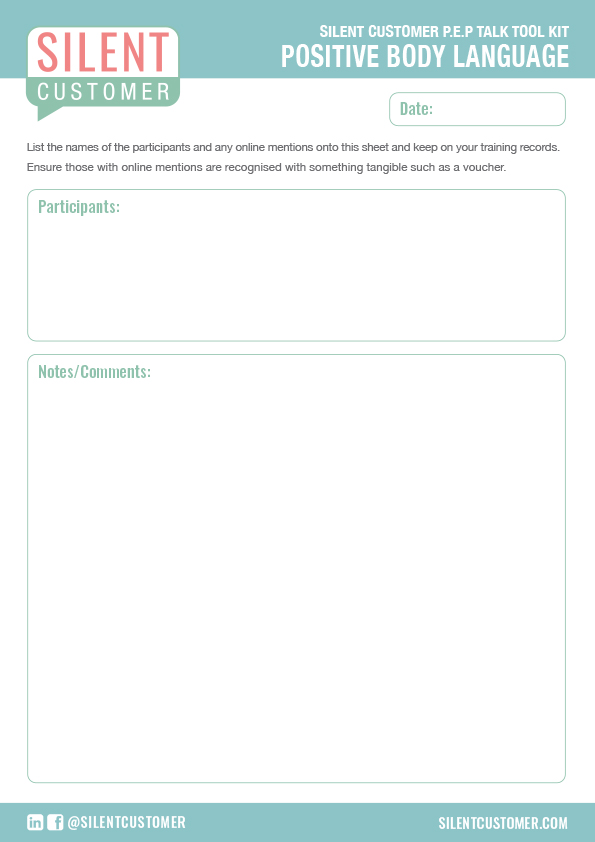
That’s why we created the Positive Body Language tool as part of our P.E.P Talk Toolkit — a free resource for hospitality teams to explore, practice, and reflect on the impact of their non-verbal communication.

Here’s how it works:

Produce: Start by reading out positive feedback your team has received. This anchors the conversation in strengths and builds confidence.

Explore: Engage your team in a discussion about what non-verbal communication means. Use prompts to explore open vs. closed body language, mirroring, and vocal tone.

Practice: Challenge team members to make a closed-off customer smile, or get someone to mirror their positive energy — just like Wade’s “one table an hour” idea.

These practices aren’t just about customer service. They’re about helping young, often inexperienced team members become more self-aware, confident, and empathetic — both on the job and in life.

By blending Erin Wade’s insights with our P.E.P Talk framework, you can unlock fresh energy and engagement on your floor. Start small. Be intentional. And most of all — make it fun.

Download the Positive Body Language training tool now from our free training page:

www.silentcustomer.com/free-training-tools

Let’s help every table — one at a time — feel truly welcome.

If you would like to gain a deeper insight into your customers’ experience, motivate your team, and strengthen your brand’s reputation, Silent Customer offers a comprehensive mystery dining service tailored to your business needs. Contact one of our friendly team to find out more. 
Share:

Twitter
LinkedIn
Facebook

Related Posts

Do GMs have a parental role?

Do GM’s have a parental role? In a word – Yes. Adults are really just grown-up children. We might not throw ourselves on the floor anymore, but we still have our versions of tantrums. Most of us keep them inside; a few make their displeasure known. Either way, angst and tears rarely help anyone. Remember Super Nanny? The meltdowns were almost always for the same reasons: 📍Parents hadn’t set clear expectations 📍They hadn’t modelled the

Read More »

Q: Why are my Google reviews disappearing?

A: In 2025 and 2026, Google has dramatically increased its moderation of business reviews. It appears this has ramped up in late January 2026. This means that many reviews – both positive and negative – are being removed from business profiles across all industries. This is a widespread issue affecting businesses globally, including restaurants, automotive, home services, retails and insurance agencies. The main reasons for these removals include: Automated moderation by Google’s systems, which uses artificial

Read More »

What is complex feedback and why do I need it?

Machine Learning v Human Learning. Machine Learning (AI as it has been branded) has been around for 20 years. It just didn’t have the funding or commercial focus to make money until recently. Currently, it tells us stuff that we tell it. It needs information and instruction to give an output, which mostly comes from us humans. The AI the majority of us have access to doesn’t learn further than how it has been programmed.

Read More »

Okay, it’s Fortnum’s, but EVEN SO!

This is Meghan and me on our annual Christmas pilgrimage to Fortnum’s. We do the rounds and then have a glass of bubbles and some mini sausages in the 3’6 Bar (never thought to ask why it’s called that). Anyway… later that day, I realised I must have left my phone on the sofa there. Doh! Mind you, if you’re going to leave your phone anywhere in London, right? The phone call. I phoned Fortnum’s,

Read More »

Behind the Scenes at Silent Customer: Experience, Resilience, and Real Service

Personally, and business-wise, it’s been an absolute bugger of a year so far.   My mother passed away in Feb after a short battle with Cancer. The day after she died the GP ‘fast-tracked’ my other half for suspected cancer. (It wasn’t – thankfully).   At the same time, I was suffering from awful bladder plain which has since been diagnosed as chronic and incurable.   I’ve had hand surgery, and there’s more besides.  

Read More »

Has the smaller pool of front of house talent made it harder to deliver a great service experience?

Employed people in hospitality are super expensive, difficult to come by, and it seems, lacking in basic people skills and practical logic. I ran my first restaurant as a general manager 30 years ago when I was 21. Food and labour costs were stressful to manage then. Chefs were difficult to come by, although not nigh-on-impossible as it is now.  However, front of house people dropped application forms off in droves. There was more choice

Read More »

Reputation Management

Mystery Visits

Phone & Online Audits

Free Training Tools

Free Training Tools

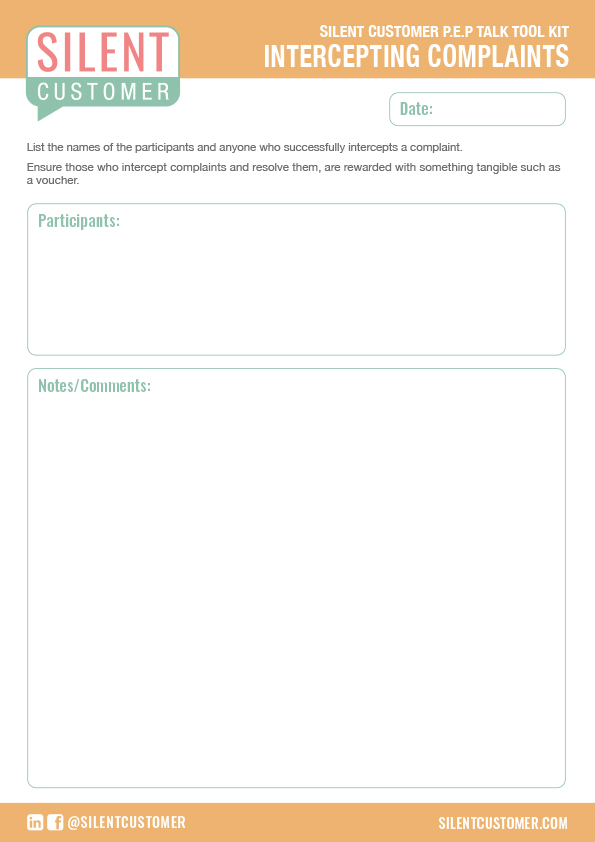
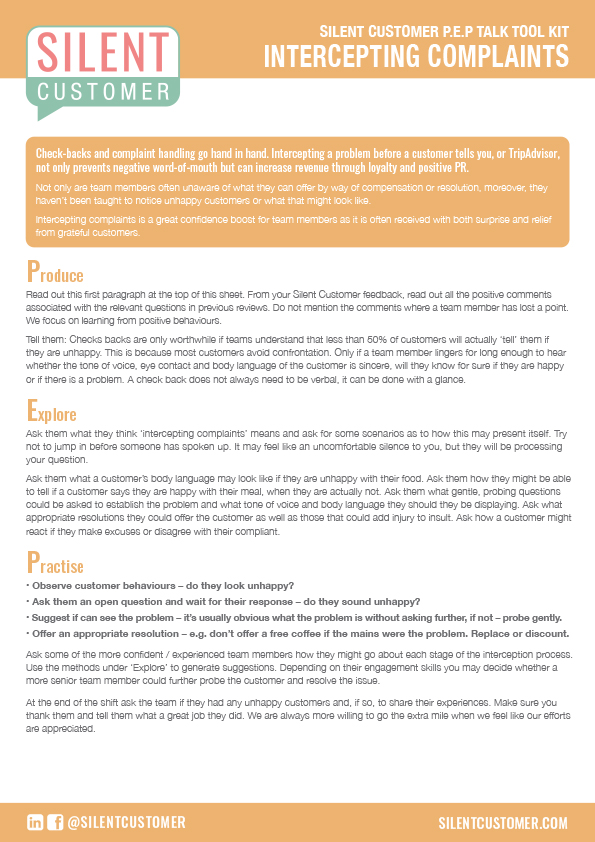
Intercepting Complaints

Check-backs and complaint handling go hand in hand. Intercepting a problem before a customer tells you, or Google, not only prevents negative word-of-mouth but can increase revenue through loyalty and positive PR.

Use our fun PEP talk sheets to support your front-line teams in learning how to avoid complaints.

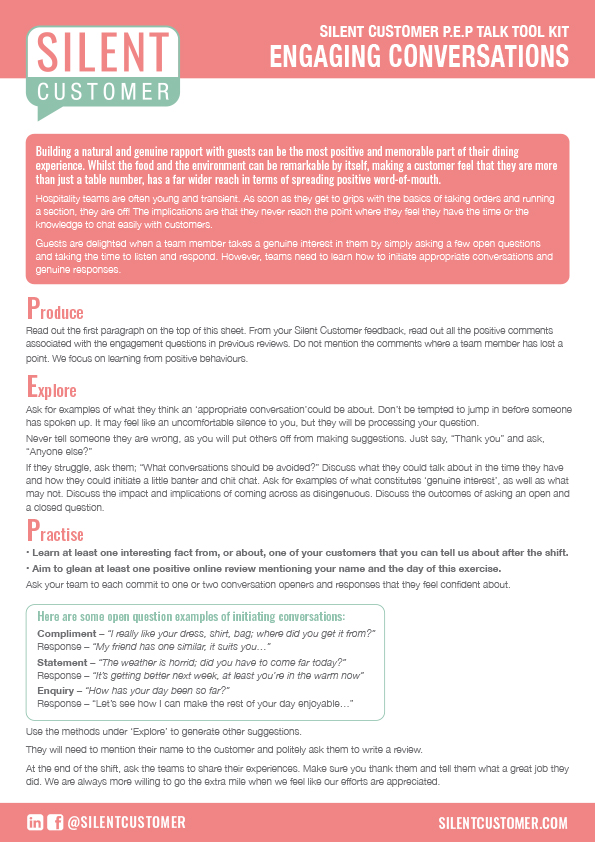
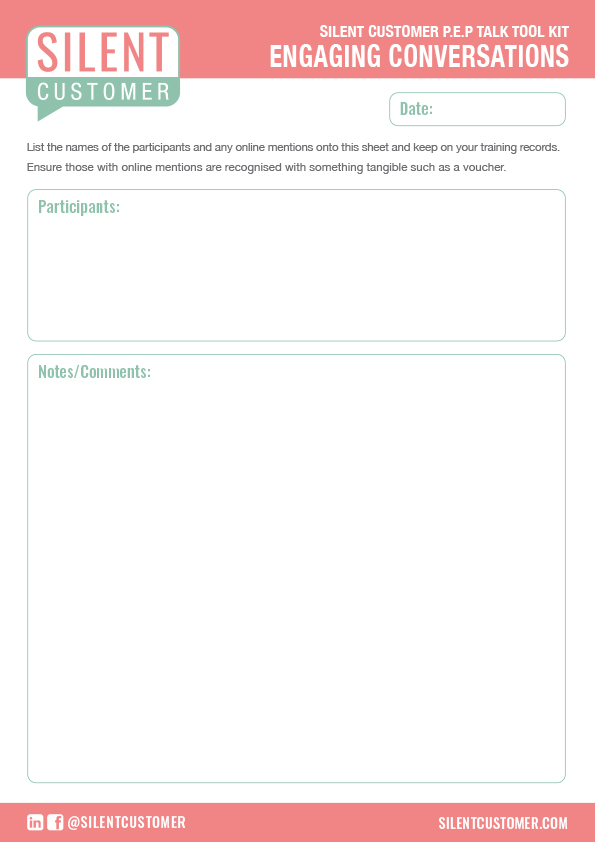
Engaging Conversations

Building a natural and genuine rapport with guests can be the most positive and memorable part of their dining experience. Whilst the food and the environment can be remarkable by itself, making a customer feel that they are more than just a table number, has a far wider reach in terms of spreading positive word-of-mouth.

Use our fun PEP talk sheet to support your front-line teams in learning how to have engaging conversations.

Positive Body Language

Being able to communicate positivity, and with enthusiasm, encourages customers to reciprocate in the same manner. However, most of us are unaware of how we are perceived by others and, whilst we may think we are coming across as welcoming and friendly, our body language could be telling a different story.

Use our fun PEP talk sheet to support your front-line teams in understand the importance of self-awareness.

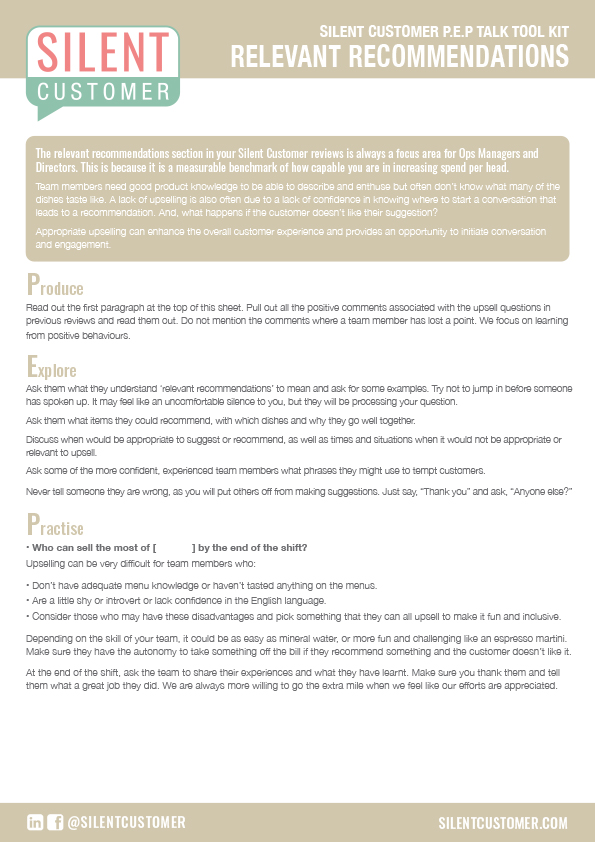
Relevant Recommendations

Team members need good product knowledge to be able to describe and enthuse, but often don’t know what many of the dishes taste like. A lack of upselling is also often due to a lack of confidence in knowing where to start a conversation that leads to a recommendation.

Use our fun PEP talk sheet to support your front-line teams in learning how to upsell.